
Last week’s executive luncheon was one for the books – both literally and figuratively. We welcomed Charlene Li back to the DMV. We celebrated her seventh book: Winning with AI: The 90-Day Blueprint for Success.
Below you’ll find some gems from the confidential boardroom discussions. Here’s why we design these sessions, and why this matters:
- We will be tempted to turn to our former change leadership strategies for guidance. But we lack a playbook for this era. We touched on this briefly during my 88th episode (livestream replay here).
Here’s why: The pace of change is unprecedented, traditional “command and control” structures are crumbling, and team trust faces disrepair. Here’s evidence: This week, the Federal Reserve of New York reported worker satisfaction reaching “all time lows.”
And the “move fast/fail fast” tropes? They do not always work, either. The Anthropic executive team chose a less popular tech industry tact by slowing the release of Mythos to 50 monoliths such as JPMorgan Chase, Nvidia, Cisco, and AWS. Their announcement feels like jazz hands to me. Yet, they are slower moving jazz hands.
Despite outlier examples such as the Mythos Mildrollout, our executive members still expressed rapid change whiplash. We are all human. We can only absorb so much. Brains are like sponges.
2. Our response to the AI revolution defines how we lead and live for years to come.
AI’s ripple across multiple facets of our lives at once: our work habits, our organization design, communication channels, privacy, our human interactions, and our planetary resources (including data center proliferation, declining natural habitats, and strained water supplies).
That’s why Leading with AI is timely. She and co-author Katia Walsh, Ph.D. invested several years to teach us modern-day, AI-informed business strategy. Yet they have adapted their tools, resources, and case studies to the new geopolitical, societal, and economic realities.
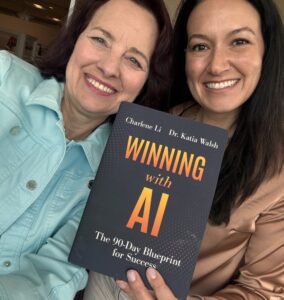
Me with our host, Erica Goodwin. We are both featured in this book and applaud Charlene and Katia.
Here are five lifeboat supply strategies we covered last week:
- Replace AI first strategy language with AI fluent teams.
How to know you’re AI-fluent? When you can teach your learnings to peers. Charlene expands further:
“Literacy is knowing what AI is. Fluency is reaching for it naturally…when using AI becomes second nature, the way you’d reach for a search engine without deliberating about it first.”
Executives outpacing competitors replace AI platitudes with practice. With help from Charlene, Jenny and Michael (fellow business owners), we created an AI Growth Group in 2022. Those monthly meetings helped me boost my literacy AND fluency.
As the founder of the Marketing Growth Leaders, I went one step further. Together with Geoff Livingston, we launched an “AI for Executives” series for our members earlier this year. The sessions saved our C-Suite clients dozens of hours of work each month.
In our community, proactive leaders are investing in their own education — even when their employers hesitate or delay. Contact me for a vetted list of courses designed for senior leaders.
2. Skip the “fail fast” talk track.
Here’s an alternative: learn fast. Charlene outlined three questions every organization needs to answer now, in no particular order:
- What kind of training does our team need?
- What tools will be buy?
- How might we allocate time for everyone to experiment with AI?
These questions help you learn fast and iterate — not fail fast and scramble.
3. Ditch the readiness assessments.
This lifeboat supply will upset AI and IT consulting practitioners. Some have designed their business models around paid assessments.
These time wasters will not help you grow, nor teach teams to experiment.AI readiness assessments introduce delays. Here’s proof.
During our session, Charlene asked our group: “How many of you have seen a feasibility study that ever gives the green light to a new initiative?”
Nobody raised their hand.
Consider this step instead: a gap analysis. Identify the building blocks required to shift your culture, improve governance, security, privacy, and team fluency. Then build a 90-day plan to close those gaps. Winning with AI (order link here) offers worksheets and case studies that will save you significant time on implementation.
4. Ground the pilot projects.
Focus on a portfolio of projects tied to your critical business strategy and prepare your teams for AI takeoff. Charlene breaks the portfolio into three categories:
- Quick wins
- Medium-term wins
- Long shots
This propels your organization forward — rather than keeping you trapped in endless pilots that go nowhere.
5. Bring AI to lunch—and to the boardroom.
Before a critical meeting, one luncheon CEO participant asks his team members: “How did you use AI to prepare for our meeting and shape your ideas?”
Here’s another example. Coursera partners with Yale, Stanford University, IBM, Google and others to offer AI courses. Former Coursera CEOJeff Maggioncalda modeled AI forward action, and it paid dividends.
In 2022, a team member showed him a ChatGPT-generated product strategy–a turning point for the company. Jeff became obsessed with learning AI to boost market expansion and team adoption.
Jeff made big moves at unprecedented speed. Within 90 days, he launched “Project Genesis” – Coursera’s AI roadmap. He also personally delivered a popular “Navigating Generative AI: A CEO Playbook.” course, reaching over 11,000 learners. I took the course and highly recommend it.
That’s not lip service. It’s visible commitment.
How you navigate this new AI landscape is how you will handle other unexpected strategic threats. These five distinctions help you stand out in a sea of industry sameness. Add them to your lifeboat before the next transition tsunami hits.
Lisa
Copyright 2026, Lisa Nirell. All rights reserved. I did not use AI to write this article.